
When should I be concerned?
Not as often as you might have been led to believe. Most of us want to live long, healthy lives and we want our children to have better lives than ours. We do the best we can to make the right decisions regarding what to eat, how to live, and when to go to the doctor. We teach our children to look both ways before crossing the road. We worry about making a good impression, our children and drugs, making ends meet at the end of the month, and how we’re going to be able to pay for those braces.
We have a lot to be concerned about. Some people say small amounts of radiation are good for you while others say there is no amount of radiation that is safe. So why can’t someone make it easy to decide when or if you should worry about radiation exposure? That is exactly what we’re going to do here—help by providing the facts. In the rest of this section we are going to make some statements that might be startling to some. We’re going to say things others don’t or won’t say. The statements can be argued with if people want to get into technical details, but when we look at all of the information—and radiation is one of the most studied health hazards ever—these are the conclusions we draw. (If you want additional information on why there is disagreement about the effects of low-level radiation, we have provided this in another section. [link to disagreement paper]
First, we have to discuss a radiation unit with you; radiation specialists use the unit “rem” to describe the amount of radiation dose someone has received. We are going to use that unit throughout all of the sections. Without getting into the technical specifics about that unit, it is enough just to know that it indicates a measure of how much radiation energy is absorbed in our body and how effective it will be in causing change. And, as we will see in other sections, the total energy that is absorbed and its effectiveness in causing change is the basis for determining whether health effects may result.
We’ll get into some detail later, but for a baseline—
- 1 rem received in a short period or over a long period is safe—we don’t expect observable health effects.
- 10 rem received in a short time or over a long period is safe—we don’t expect immediate observable health effects, although your chances of getting cancer might be very slightly increased.
- 100 rem received in a short time can cause observable health effects from which your body will likely recover, and 100 rem received over many years will increase your chances of getting cancer.
- 1,000 rem in a short or long period of time will cause immediately observable health effects and could cause death.
Is it really that simple? Yes, it can be. You can use this information just as it states—if you receive 1 rem of radiation dose, it is safe and you don’t have to be concerned. If you receive 100 rem, there is likely to be an observable health effect. The types of health effects from radiation depend on a lot of things, and this is discussed in other sections. Even with that in mind, the little chart above is still true.
So why do some people say radiation exposure is bad and others say it can be okay? Even the scientific community differs on the answer to the question of radiation doses and health effects. Radiation can cause biological changes in cells that can be seen in a laboratory even when the dose is small. This may make it seem harmful for some people. However, these changes are not seen or cannot be related to health effects in humans. This may make others believe it is safe and, when the radiation exposure is related to a recognizable benefit, it may be seen as good. The human health effects that have been observed are when individuals or groups have received larger doses of radiation (more than 10 rem) from events like those due to military uses of nuclear weapons, accidents, and uses of radiation in medicine for therapy.
There is no magic level of radiation that is absolutely safe for everyone because each of us is different. If a population receives a radiation dose of 100 rem in a short period of time, we expect health effects in some of the people who were exposed. However, some who receive a dose at that level may not have any long-lasting health effects. This is like so many other things in our lives. If we eat a high-cholesterol, high-fat diet, some of us may end up with heart disease. But that isn’t true for everyone; some can eat this way for a lifetime and not have any heart disease issues.
It isn’t a complete guessing game, though. Because radiation has been studied so much, there are some things we can say with certainty that apply to a majority of the population. We can say that for a small radiation dose (<10 rem), the risk of cancer is very small, too small to have any observable health impact in the population of the United States. We know that if the radiation dose is quite large and given in a short period of time, like the 1,000 rem in the chart above, it will cause the individual to be very sick and die.
With that in mind, let’s fill in the chart with a little bit more of what we know about getting a radiation dose to our entire body:
- 0-5 rem received in a short period or over a long period is safe—we don’t expect observable health effects.
- 5-50 rem received in a short period or over a long period is safe—we don’t expect observable health effects, although above 10 rem your chances of getting cancer are slightly increased. We may also see short-term blood cell decreases for doses of about 50 rem received in a matter of minutes.
- 50-100 rem received in a short time will likely cause some observable health effects and received over a long period will increase your chances of getting cancer. Above 50 rem we may see some changes in blood cells, but the blood system quickly recovers.
- 100-200 rem received in a short time will cause nausea and fatigue. 100-200 rem received over a long period will increase your chances of getting cancer.
- 200-300 rem received in a short time will cause nausea and vomiting within 24-48 hours. Medical attention should be sought.
- 300-500 rem received in a short time will cause nausea, vomiting, and diarrhea within hours. Loss of hair and appetite occurs within a week. Medical attention must be sought for survival; 50 percent of people exposed to radiation at this high level will die if they receive no medical attention.
- 500-1,200 rem in a short time will likely lead to death within a few days.
- >10,000 rem in a short time will lead to death within a few hours.
The health effects listed above are for a radiation dose to the entire body. If the radiation is given to a smaller area of the body, there are other effects that may occur, but illness or death is not expected unless noted –
- 40 rem or more locally to the eyes can cause cataracts.
- 100-500 rem or more can cause hair loss for a section of the body that has hair.
- 200 more rem locally to the skin can cause skin reddening (similar to a sunburn).
- 1,000 rem or more can cause a breakdown of the intestinal lining leading to internal bleeding, which can lead to illness and death when the dose is to the abdomen.
- >1,500 rem or more locally to the skin can cause skin reddening and blistering.
Radiation doses at levels known to cause observable health effects rarely occur on purpose except for some medical radiation therapies. By now you have to be asking what the level of radiation dose is for procedures you are familiar with, like x-ray examinations, compared to the doses in the chart. We want to get to that, but we first need to talk about radiation and cancer.
This discussion isn’t as easy as the one above where we can be more specific and say “here’s a dose and here’s the effect of that dose.” Cancers produced by radiation are the same as any other cancer plus they don’t occur for possibly up to 40 years! With cancer, it’s about the risk or odds (probability) of getting cancer. We make probability decisions every day based on how we feel about something –“What are the chances I’ll get a raise if I go ask the boss for one?” “I wonder if I can fit one more stop in on the way home and still be on time.” “If I have another piece of candy, will I gain weight?” Based on how you’re feeling and what the benefits might be, you weigh the odds and make a decision.
With radiation and cancer, it is much the same type of question, but in this case it looks like “What is the chance of cancer from this radiation dose?” Whether the chance is “big” or not is a personal decision – based on your thinking about radiation and whether you think there is a benefit to you. Using the doses on our original chart, here is the percentage increase in the chance of getting cancer (keeping in mind that our everyday, ordinary risk is about 42 percent without radiation exposure):
| # Cancers That Occur Over a Lifetime in a Population of One Million People | Odds of Cancer (natural occurrence) | |
|---|---|---|
| Cancer Baseline |
420,000*
|
1 in 2.4
|
| POSSIBLE INCREASE IN CANCER CAUSED BY EXPOSURE TO RADIATION ABOVE THE NATURALLY OCCURRING BACKGROUND | ||
| Dose | # Possible Cancers if One Million People Receive that Dose | Combined Odds of Cancer (natural occurrence + the additional risk if you receive the dose in column 1) |
|
1 rem
|
421,700 |
1 in 2.4 |
|
10 rem
|
437,000 |
1 in 2.3 |
|
100 rem
|
590,000 |
1 in 1.7 |
|
1000 rem
|
A person would die before cancer could occur |
|
*Average male plus female lifetime incidence (http://srab.cancer.gov/devcan)
**Adapted from ICRP 2007, Appendix A, Table A14 (17%/Sv [or 17%/100 rem] incidence)
Okay, we’re ready now to see some regularly encountered radiation doses using a chart layout similar to the first two charts in this section. The numbers given below are the radiation dose we expect most people would receive from that source.
| Effective Dose | Radiation Source |
|---|---|
| Less than (<) or equal to (=) 0.001 rem | annual dose living at nuclear power plant perimeterbitewing, panoramic, or full-mouth dental x rays |
| <=0.01 rem | skull x ray chest x ray |
| <=0.1 rem | single spine x ray abdominal x ray pelvic x ray hip x ray mammogram |
| <=0.5 rem | kidney series of x rays (IVP) most barium-related x rays head CT any spine x-ray series annual natural background radiation dosemost nuclear medicine liver, kidney, bone, or lung scansmost nuclear medicine brain scans |
| <=1.0 rem | barium enema (x rays of the large intestine)chest, abdomen, or pelvic CT |
| <=5.0 rem | cardiac catheterization (heart x rays) coronary angiogram (heart x rays) other heart x-ray studies most nuclear medicine heart scans |
Now let’s put those last two charts together for some examples. Without radiation exposure, my risk of cancer is 42 percent (chances of 1 in 2.4). If I have a pelvic CT scan (dose <= 1 rem), my risk of cancer is now 42.17 percent (chances of 1 in 2.4). If I have 10 CT scans, my risk of cancer is now 43.7 percent (chances of 1 in 2.3). If I live next to the perimeter fence around a nuclear power plant for 40 years, my risk of cancer goes from 42 percent to 42 percent plus (.00017 percent x 40 years) = 42.017 percent (chances of 1 in 2.4; the same as baseline or with no radiation exposure).
With that information we now have a better understanding of the approximate risks of radiation doses. We can see that radiation doses less than 10 rem are unlikely to cause harmful effects and only slightly increase our chances of getting cancer. Whether to be concerned or not is still a personal decision. Taking steps to keep our exposure to any potentially harmful agent reasonably small is important. It is our personal responsibility for us and our families.
We must, however, try to make informed decisions based on the real and not the perceived risks in our everyday lives. When we do that, we can lower or eliminate the higher risks over which we have control and not agonize over lowering risks that are already low. Often, we believe that if radiation is present that there is a high risk. As can be seen from the charts and the information in this section, we know this is not true. To compare the chances of getting cancer from radiation exposure to other, more common, chances of diseases or accidents, see our Probability Table.
And Finally…
Here are some answers to questions you might still have about whether radiation can hurt you.
I keep hearing that no amount of radiation is safe. Now this document says that some of it is. Which is it?
Low levels of radiation exposure are safe. The exposure does carry some risk, and the level of risk is the same or less than other day-to-day activities we consider safe or acceptable.
Whether something is truly safe is based on how each individual sees it. Every day we face risks of various sorts without much consideration. The reason? The risk is so very low that we just don’t think about it or the risk is something we are willing to take because of benefits we see (like driving your car or walking across a busy street). It is the same with a dose of radiation. When the calculated risk from radiation exposure is the same as risks we routinely take and consider acceptable, we then say that radiation exposure is also acceptable.
Why are there so many different terms when it comes to radiation? Rem, rad, curie, gray . . . what are they all for?
One reason for so many different terms is the fact that the United States uses traditional radiation units while the rest of the world uses an international system of units (very similar to the United States using inches and other countries using centimeters). It can be terribly confusing, but we’ll give it a go: in the international system, we use sievert, gray, becquerel, and coulombs/kilogram, for example, while in traditional units we use rem (= 0.01 sievert), rad (= 0.01 gray), curie (= 3.7 x 10¹⁰ becquerel), and roentgen (= 2.5 x 10⁻⁴ coulombs/kilogram).
Another reason for all the different types of units is our need, as scientists, to be precise and accurate when we are describing radiation interactions and energy left behind.
How do we know about the effects at large doses – how do we know about radiation causing skin reddening or cataracts or cancer? Did someone actually do studies on people by exposing them to radiation?
There are several reasons we know about the radiation effects at high doses. While there have been animal studies, much of our information does come from actual human radiation exposure, unfortunately, because of accidents and events. Some of the information came from the first people working with radiation, who were unaware there might be possible harmful effects and in some cases were exposed to too much radiation. Some became sick or suffered severe damage to their hands. There also has been follow-up on patients undergoing radiation therapy treatments, research focusing on people exposed to large amounts of radiation by accident, and studies of health effects in the Japanese atomic bomb survivors during World War II and in underground uranium miners.
So, no, we do not purposely expose people to large amounts of radiation just to see what effects will occur, but we do look carefully at cases where large exposures have occurred to see what we can learn.
Does this information apply to children?
 It does. Children are more sensitive to radiation, though. Our children are maturing and their bodies are growing. Generally, when an organ is developing, it is more likely to be affected if radiation interacts with it – that is why our children’s organs are more vulnerable.
What this means in our day-to-day lives is no different than what we’re doing now. We need to make sure exposure to any harmful agent is low, but if there is a benefit from radiation exposure, we need to know what the benefit will be to our child and for us. It is important for them and for you that the added chance of a harmful effect from any activity is weighed against the benefit or fun it brings and what happens without it. It is important that you have factual information.
How can I tell good radiation exposure from bad radiation exposure?
We’re not sure what “good” or “bad” radiation exposure is. Is it bad radiation exposure if you have an arm x ray and it shows that no bones are broken? Or is that a good thing because now you know it is only a sprain? The reason for a person to receive a radiation dose should be justified based on the expectation that the activity causing the radiation will benefit the individual exposed or society. We might think that radiation is good when we can see the benefit right away. We might, on the other hand, think other radiation is bad if we can’t figure out what the benefits may be.
So, whether it is good or bad will depend on whether you think you are getting any benefit from it as an individual or as a member of society.
What about women who are pregnant? What situations should cause concern?
This is such an important topic that we’ve chosen to go into more detail than an answer to one question can provide. Go to our appendix on pregnancy and reproductive hazards of radiation to learn more or visit the Ask the Experts Web site where pregnancy and reproductive hazards are discussed.
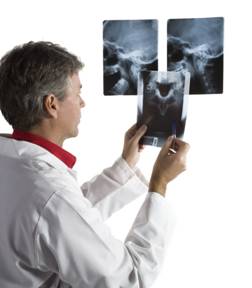 So, if I had x rays off and on when I was a kid (broken arm sprained ankle, chest x ray, and more), do I need to be concerned?
No. If they were standard diagnostic x-ray exams, there is no need to worry because even the total radiation exposure you received would be on those charts in the lower radiation dose ranges that we call safe.
How do we know that the radiation exposure we received isn’t going to cause cancer?
We don’t. It’s like getting in a car to drive to work. We can’t predict whether we will be in an accident or not. Even if we drive very carefully, doing all the right things, we still don’t know what will happen. With radiation exposure, it is the same – at the lower levels indicated in the charts, the chance of developing cancer or seeing other effects is very low.
I don’t really follow the information in the charts. I see it takes a lot of radiation to cause some things. I just want to know what is my risk of cancer if I have a spine x ray?
Okay, that’s fair. How about if we look at it this way – here are the radiation sources, the approximate dose of radiation you get from them, and how much your chances of getting cancer increases in your lifetime as a result of that radiation dose. Remember, with no extra radiation dose, your odds of getting cancer in your lifetime are about 10 out of 24 (or 1 in 2.4) – nearly 50 percent.
| Radiation Source | Effective Dose | Additional Chances of Getting Cancer* |
|---|---|---|
|
bitewing dental film |
Less than (<) or equal to (=) 0.001 rem |
1 in 600,000 |
|
skull x ray |
<=0.01 rem |
1 in 60,000 |
|
spine x ray |
<=0.1 rem |
1 in 6,000 |
|
kidney series of x rays (IVP) most barium-related x rays head CT most nuclear medicine liver, kidney, bone, brain, or lung scans |
<=0.5 rem |
1 in 1,200 |
|
barium enema |
<=1.0 rem |
1 in 600 |
|
cardiac catheterization most nuclear medicine heart scans |
<=5.0 rem |
1 in 120 |
*Numbers from the National Radiation Protection Board (now the United Kingdom Health Protection Authority)
So you can see that even with many types of radiation exposures and medical exams, the ordinary everyday odds of dying from cancer (1 in 2.4) are much higher than the added chances of getting cancer from radiation.
Who regulates radiation? Can I trust that they make sure I am not exposed to too much radiation?
There are many regulators in the United States for various aspects of radiation uses and types of exposures. The Food and Drug Administration regulates the approval of devices that emit radiation (such as x-ray machines) and state health departments regulate the use of these devices, the use of radioactive materials and releases of radioactive material that could expose the public. The states, the Nuclear Regulatory Commission, and the Occupational Safety and Health Administration regulate how people work with various devices and radioactive materials and how much radiation exposure they can receive as a result of the work they do. One of our appendices shows these and some other radiation-regulating and scientific groups, tells a little about what they do, and gives Web site information.
How do I protect myself?
Before we talk about protection, let’s talk about need and benefit because we think it all goes together. We each need to be careful in considering what we are doing or are about to do. If we hurt, we finally decide to go to the doctor who, often, can help us with some type of pill. If we read the package insert for that pill, we will see that there are a number of side effects that can occur if we take it. We choose to take that pill anyway because it will make us feel better and we are either willing to risk the side effects or we have decided that the chance of them occurring is small.
That is how we assess the need and benefit of taking a risk. I need the pill because I hurt, the pill will benefit me by taking away my pain, and I’ve decided any of the side effects of the pill aren’t worthy of my concern. We need to give the same considerations to the various potential radiation situations. Some situations are easier to consider than others because the benefit is more obvious. We fall out of a tree and have an x ray to see if we broke our leg or just hurt it badly. We want to reduce our dependency on foreign oil, and nuclear power is one option that offers a clean source of electrical energy. So, to protect yourself (1) be informed, (2) learn why you are going to receive a dose of radiation and what the dose is likely to be, (3) evaluate the concern with that level of radiation, and (4) if the level warrants, evaluate whether there are ways to lower the radiation dose.