
Will small radiation doses hurt me?
No. Every day we live with radioactive materials around and inside our bodies as well as what is normally in our environment. However, a large dose of certain types of radiation could be harmful. That is the same answer I would give you if you asked if taking a bottle of pain pills could hurt you . . . yes, for certain types of pills and if you take enough of them. To put it briefly . . . in every medicine there is a little poison. If we use radiation safely, there are benefits. If we use radiation carelessly, there are consequences.
 Some types of radiation can change the structure of the cells in tissues with which the radiation comes in contact. If radiation changes the structure, sometimes potentially harmful items are created. This matters to us because these potentially harmful items are more likely to cause changes in tissue; they can interfere with cellular processes so cells might not be able to divide or they might divide too much.
 Although radiation can have the potential to damage any structure inside a cell, the structure of most concern is the DNA (deoxyribonucleic acid) because DNA contains the genetic information that allows us to function, grow, and reproduce. If DNA is damaged from radiation or some other agent (like toxic particles in smog), it has the capability to repair mild damage. However, if the damage can’t be repaired or is not repaired correctly, harmful effects may occur. These effects may or may not affect how we function on a day-to-day basis. If the cells are not very important to the operation of our body, it may not matter that they have been damaged or killed. However, if the cells are in critical organs (ones that keep us alive) and a large number of the cells have been damaged or killed, that organ might not be able to function any longer.
Here is a summary of some of the things that can happen if a cell is damaged:
- The cell might have some mild damage that is repaired,
- The cell might have some mild damage that sits inactive until another agent interacts with the cell again,
- The cell (if it is a reproductive cell like sperm or egg cells) might have damage to the genetic code that doesn’t show up until future generations (your children, their children, etc.),
- The cell might have some damage causing it to become a cancerous tumor,
- The cell simply stops functioning, or
- The cell is killed.
Some effects may occur immediately (days or months) while others might take tens of years or even get passed to the next generation. Effects of interest for the person being exposed to radiation are called somatic effects and effects of interest that affect our children are called genetic effects.
We know a lot about the interaction of radiation and effects it can have on the human body. The effects depend on many factors, including the type of radiation and how we are exposed to that radiation and our own genetic makeup. We might be exposed from the outside—like an x ray—or from the inside—if we have radioactive materials inside of us—or from both. We might be exposed over a long period of time or we might be exposed once in a very short time. And we might be only partially exposed—like our leg during a knee x ray—or our whole body might be exposed all at once—like our exposure to daily natural background radiation. Some of us are more susceptible to radiation injury than others—we sunburn more easily, for example.
Before we begin, we need to briefly define what we mean when we say radiation “exposure” and radiation “dose.” When we say someone has been exposed to radiation, it simply means that the person interacted somehow with radiation—it’s like saying we were exposed to the sun, which means our body or a part of our body was out in the sun. Neither of those tells us how much of a dose we received—we were exposed to x rays or we were exposed to the sun, neither is an indication of dose. In the case of radiation, if we are exposed and some of the energy from the radiation stays in our body, that is radiation dose. Radiation dose is the energy deposited in our cells and tissues from some exposure to radiation.
External versus Internal Exposure
Let’s first look at route of exposure. When we hear the words “radiation exposure,” we generally think of radiation beaming out from a source and striking the outside of our body. 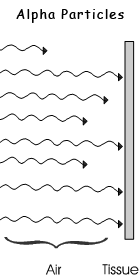 However, radiation can also be in the form of alpha and beta particles or gamma rays that come from radioactive material and that can leave their energy in internal organs if ingested, injected, or inhaled. As a result, it is important to consider not only the type of radiation emitted from a source but also the way it is absorbed. There are three main ways to be exposed to and absorb a dose from radiation: external exposure, internal exposure, and skin contamination.
External Exposure
External exposure is radiation that comes from somewhere outside the body and interacts with us. The source of radiation can be a piece of equipment that produces the radiation, like an x-ray machine, or it can be from radioactive materials in a container. The exposure occurs when the radiation from these sources interacts with our body and the dose occurs when the radiation leaves some of the energy in our body.
Sources outside the body that emit x or gamma rays can be external radiation exposure hazards. The amount of external radiation exposure you can receive is related to your distance from the source, the energy of the emitted radiation, the total amount of radioactive material present 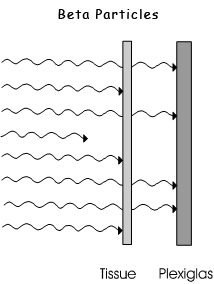 or the machine setting, and the time of exposure.
Alpha and beta particles, in general, constitute no external exposure hazard because the particles generally do not pass through skin. However, high-energy beta particles can cause a large skin dose if allowed to be on the skin for a long time because they will leave much of their energy there.
Internal Exposure
Internal radiation exposure hazards result from radioactive material that gets inside the body when you breathe it or eat it or when it passes through your skin. Internal radioactive materials produce radiation exposure the entire time they are in the body until the material is no longer radioactive (it decays) or is removed naturally by the body. It was mentioned that external radiation exposure is unlikely from alpha and beta particles. Internal exposure, however, can come from all types of radioactive materials if they are inside the body. Once inside, much of the radiation energy will get absorbed in cells, tissues and organs. The extent of an internal radiation dose is related to the amount 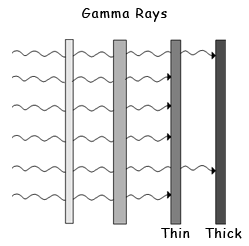 of material inside the body, where it goes in the body, how long it stays in the body, and the type of radiation it emits.
Unlike the skin on the outside of the body, there is nothing inside us to protect cells and tissues from the potentially damaging effects of alpha and beta particles. Alpha particles can be very hazardous internally because an alpha particle does not travel very far and its energy is deposited within a small volume increasing the chance of cell death.
Where the radioactive material travels when it is inside the body depends on what organs or tissues in the body use the material – these are called target tissues or target organs. For instance, our bones need calcium and when we eat something high in calcium, like milk, our body takes the calcium to our bones. If the calcium is radioactive, our bones will absorb that, too. If the material isn’t used by anything in our body, our body will get rid of it.
To summarize external and internal radiation hazards:
- Alpha particles are not a hazard outside the body because they cannot penetrate the dead layer of skin covering our bodies (they also cannot penetrate a piece of paper!).
- Beta particles are not usually a hazard outside of the body; however, they could cause a dose to the skin if on the skin in a large quantity.
- All types of radiation are an exposure hazard inside the body.
- Radiation dose from external sources depends on time of exposure, distance from the source, and the intensity, type and energy of the radiation.
- Radiation dose from internal sources depends on how much radioactive material is inside the body, where it goes, how long it stays there, and the type and energy of radiation emitted.
- Somatic effects are the effects that might happen to the people who were exposed to radiation while genetic effects are effects that might show up in their children.
Skin Contamination
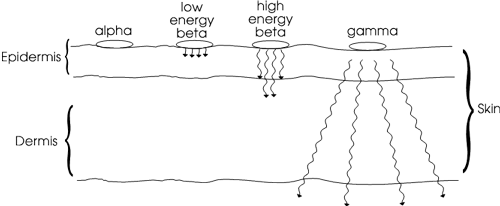
Skin contamination is something that might occur, for instance, if liquid radioactive materials are accidentally dripped onto the skin. Alpha particles cannot even penetrate the dead layer of skin. Some beta particles can deliver a skin radiation dose if they are on the skin long enough. Some x- and gamma-ray-emitters can also deliver a skin radiation dose but, additionally, they can be a hazard to other body tissues because the x- or gamma-ray-emitting radioactive material is sitting on the skin and the x or gamma rays are more penetrating and can travel into the body.
Radioactive material on the skin that is absorbed or passes through a cut and gets inside the body is considered an internal radiation hazard.
Acute versus Chronic Exposure
Now let’s look at how long the exposure lasts. First, think of a medical x-ray exposure where the time of exposure is short – the machine is on and off within a very short period of time. Or think about radioactive materials that naturally occur in our soils; they present us with small amounts of radiation exposure that occur over our lifetime. Depending on the source, time of an exposure can vary – in some cases, the time will be very short, seconds or less, and in other cases it will be occurring continuously over our lifetime. Keep in mind that being exposed to radiation in a short period of time or over a long period of time is no indication of the total radiation dose and, thus, the possible health effects that may occur.
Acute Exposure
Acute exposure is radiation exposure that occurs in a short time period. It can be an exposure that occurs once in your lifetime. This might be that one foot x ray you had because you may have broken your foot. Acute exposure can also be exposures that occur more than once, but very infrequently and for short periods of time. This might be dental x rays you get every few years.
Acute exposure can result in a small radiation dose, like the dental x ray, or a large radiation dose, like a person might receive in an accident situation.
Chronic Exposure
Chronic exposure is radiation exposure that occurs over a long period of time. It can be continuous exposure like the radiation exposure we receive daily from natural background radiation or it can be radiation exposure that occurs off and on routinely over a long period of time in your life, for instance, occupational radiation exposure – getting exposed to radiation at work almost daily over your working lifetime. Chronic exposure can result in small or large radiation doses.
Partial versus Total-Body Exposure
A third part of figuring out whether radiation might cause harmful effects has to do with the part of the body that is being exposed. With natural background radiation, our whole body is exposed. With a heart x ray, the heart (our chest) is being exposed. Sometimes many different parts of the body might be exposed at the same time with some of the areas or organs getting a larger dose than other areas. That is the case with most nuclear medicine exams. Radioactive material is usually injected into a patient and gets passed through the body by the blood, finally stopping in specific organs. In that case, the total body receives some radiation dose while the organ or organs that collect the radioactive material receive more radiation dose.
The amount of the body that receives a radiation dose and the location of the dose are related to the potential harmful effects. We will consider three circumstances related to size and location of radiation dose. For this section, the term “critical organ” is being used and is defined as an organ that must continue to function for us to be able to live.
Partial Exposure – No Critical Organs Exposed
When we say that there was partial exposure of the body, but there was very little or no radiation dose to a critical organ, we are talking about exposure to a hand, knee, shoulder, foot, etc. Most often with very little or no critical organ exposure, there would be little reason for concern with biological effects. Sometimes, although very rarely, with partial exposure of the body, the radiation dose received by the extremity may be large enough to cause significant injury if not properly treated.
Partial Exposure – Critical Organs Exposed
When we say that there was partial exposure of the body and it did expose a critical organ, we are talking about exposure to the pelvis, abdomen, chest, etc. – the main trunk of our body. With this type of exposure, there would be reason for concern with biological effects for the affected organs if the radiation dose is large.
Total-Body Exposure
When we say that there was exposure of the total body, we have two different situations to consider. One is the case where there is a source of radiation outside our body and it is exposing our whole body all at the same time. An example of this is radiation from the sun; it exposes our whole body all at once. The other case is when we have a source of radiation inside our body and it exposes most or the entire main trunk of the body as it travels through. An example of this would be the radioactive material (radioiodine) used to treat thyroid disorders. Although the radioactive material ends up concentrating in the thyroid, it first travels throughout the body. So, while the thyroid gets most of the radiation dose from the energy left by the radiation, the whole body gets some dose also because the radioactive material went everywhere in the body before it went to the thyroid.
If we summarize –
- Exposure from radiation sources outside the body is called external exposure and exposure from radiation sources inside the body is called internal exposure.
- Exposure from radiation sources leaves some of the radiation’s energy in body tissue – this is radiation dose.
- Chronic radiation exposure is being exposed to radiation (a little or a lot) over a long period of time, while acute radiation exposure is being exposed in a short period of time.
- Partial-body exposure may or may not include radiation exposure to critical organs, but total- body exposure nearly always means that critical organs were exposed.
And Finally…
Here are some answers to questions you might still have about whether radiation can hurt you.
What is radiation contamination and how does it differ from radiation exposure?
When radioactive materials in liquid, gas, or powder form are not kept contained, they can transfer to other surfaces or can be carried in the air. When radioactive material is “loose” and comes to rest on something, that something is then said to be contaminated – there is now radioactive material on it. If the something is a countertop, we have countertop contamination. If the radioactive material gets on our skin, we have skin contamination. If it gets inside of us, we are internally contaminated.
We need to know the type of radioactive contamination to determine whether we are being exposed to that radiation. So now it goes back to the discussion of the type of radiation (alpha, beta, gamma) and the energy of that radiation. In general, gamma radiation will expose us if it is an external source, skin contamination, or inside of us. Alpha and beta particles will expose us if they are inside of us. Some high-energy beta particles can expose us if they are on our skin.
A big difference between contamination and exposure comes when we talk about certain devices, like x-ray machines, that expose us to radiation. In this case, we are not talking about a liquid, gas, or powder, so this type of exposure does not cause contamination. Sometimes people who have an x-ray exam performed wonder if they are radioactive afterward. To become radioactive, you would need to become contaminated (have radioactive materials actually deposited on you or inside of you) and the x-ray machine does not do that.
Can radiation exposure be safe?
Yes. Radiation exposure that leads to small radiation doses for our bodies is safe. There has been no evidence of illness or increased cancer risk at small radiation doses that are similar to the amounts we receive from routine x-ray procedures, natural background radiation (excluding radon), or occupational exposure. Radiation exposure in a short period of time that leads to very large radiation doses to our body can cause health effects within months, days, or even sooner. We know from health effect studies that large radiation doses over a long period of time can lead to an increase in some diseases, like cancer.
What can too much radiation exposure do to me?
In another section, we talk about effects from various levels of radiation dose. Cancer is usually the effect that comes to mind for most people when we talk about radiation exposure and dose, but there is much more than that to talk about, including at what doses we need to be concerned.
If I am pregnant, should I just say no to any and all medical radiation exposure?
It isn’t necessary to say no to all medical exams that involve radiation. If the exam involves radiation exposure of your lower abdomen and you know you are pregnant, you need to discuss this with your healthcare provider. If your life is in jeopardy (maybe you were in a car accident and need an abdominal CT scan), the first consideration is to save your life. The amount of radiation dose you would receive from most procedures conducted to diagnose a medical condition is very unlikely to jeopardize the pregnancy.
Can the radioactive substance have hazards other than the radioactivity – like being poisonous?
Yes, it can. If the substance is hazardous to health anyway, the radioactive piece is an additional hazard on top of the hazard that exists if the substance wasn’t radioactive. An example is rat poison – the rat poison alone will make you sick and if it is radioactive, you are additionally exposed to radiation. So, if a substance by itself is cause for concern, making it radioactive adds to the concern because it can now potentially make you sick in more than one way.