
Where do I find radiation in my everyday life?
Radiation can be found in our bodies, in products we use daily, in the ground, in building materials, and in outer space. It is a natural part of our everyday life. We can commonly find sources such as x-ray machines or radioactive materials used in medicine. We use radiation mostly for its beneficial purposes such as medicine, producing electricity, or making our homes safer. Using radiation offers many societal benefits, but what is radiation exactly?
The term radiation covers a lot of things, but they are not all the same. When someone mentions the word radiation, we might think of the big mushroom cloud from a nuclear weapon explosion, the microwaves in our microwave oven, how our cell phones work, getting a suntan in a tanning salon, having a chest x ray, or nuclear power plants. In the broad category of radiation, it can be all of those things and more.
We need to narrow that broad definition of radiation to be able to talk about the type of radiation that is the focus of this information. Radiation is energy in the form of rays (beams) or particles. The radiation rays are invisible, have no weight or odor, and have no positive or negative charge. The radiation particles are also invisible, but they have weight (which is why they are called a particle) and may have a positive or negative charge. We can see and feel some types of radiation (such as light or heat), while others (such as x rays) can only be detected with special instrumentation.
X rays, gamma rays, alpha particles, and beta particles are ionizing radiation. Ionizing radiation has a lot of energy, which gives it the ability to cause changes in atoms—a process called ionization. Radio and TV signals, microwaves, and laser light are nonionizing types of radiation. Nonionizing radiation has less energy than ionizing radiation. When nonionizing radiation interacts with atoms, it does not cause ionization (hence nonionizing or not ionizing). It is important to understand what is and isn’t ionizing radiation so you can better understand what the real potential health effects might be. Although the primary focus of this material is ionizing radiation, let’s briefly look at nonionizing radiation sources to help us learn what they are and to learn what isn’t ionizing radiation.
Nonionizing Radiation Sources
We use and are exposed to nonionizing radiation sources every day. Microwave ovens use microwaves to heat food, toasters use infrared waves to heat and sometimes burn our toast, and we watch television, talk on cell phones, and listen to the radio through the use of radio waves. These are all nonionizing forms of radiation. Visible light, radar, laser light, and ultraviolet light also fall into this radiation category.
 Some forms of nonionizing radiation can damage tissues if we are exposed to too much of it. For instance, too much ultraviolet (UV) light from lying out in the sun is known to cause some skin cancers; even moderate amounts can cause skin burns.
In addition to the sun, UV waves (sometimes called UV radiation) are emitted by lights used in tanning beds, black lights, and lights used to pasteurize fruit juices. UV waves are also high energy, but unlike ionizing radiation the energy is not high enough to cause a structural change within atoms.
Visible light waves are also a form of radiation, as is the light beam emitted by a laser. A laser beam can be visible, as in the case of a laser pointer, or a laser can emit an invisible beam of UV or infrared waves. With enough energy, lasers can cause biological damage, which is why they are useful in medicine to remove warts and some skin cancers and even to break up kidney stones.
 As you can probably tell by this time, we are moving through a variety of energies as we talk about these different sources. Ionizing radiation tops the list with the highest energy, nonionizing ultraviolet waves are next. Then comes visible light waves followed by infrared waves. Infrared sources in our daily lives include toasters, toaster ovens,
 and heat lamps.
Now we get down to the lower energies where our favorite devices operate—in the radiofrequency (RF) wave range. From highest to lowest energy, this includes microwave ovens, global positioning systems, cell phones, television stations, FM radio, baby monitors,  cordless phones, garage door openers, CB radios, and AM radio. Radiofrequency waves can cause heating at high energies and with high intensities.
The last type of nonionizing radiation we’ll simply mention is extremely low frequency (ELF) waves that are produced by electrical power lines and wiring.
Ionizing Radiation Sources
Much of the information included in these modules and appendices is about ionizing radiation. This is the type of radiation, as previously mentioned, that has enough energy to change atoms in tissues. This is the radiation of chest x rays or nuclear power plant fuel. We take advantage of the properties of ionizing radiation to produce high-quality images of the inside of our body, to generate electric power, and for many manufacturing processes.
We are exposed to ionizing radiation every day. Nearly 80 percent of radiation dose we receive is from naturally occurring sources and almost all of this comes from radioactivity that is in the ground. The other 20 percent of our radiation dose comes from artificial sources – medical x rays, consumer products, industry, research, and power generation. Although the amount of radiation dose received annually by an individual will vary, the figure below shows, on average, the annual radiation dose received by each person in the United States (NCRP 93).
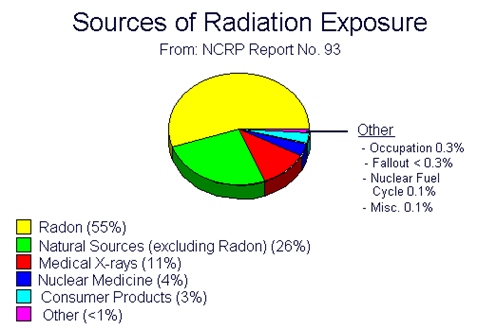
Ionizing radiation is produced by unstable atoms (radioactive atoms) or by certain types of equipment (x-ray machines and CT scanners). Unstable atoms differ from stable atoms because unstable atoms have an excess of energy or weight (or both). Unstable atoms want to be stable atoms so they get rid of some of that energy or weight (or both) to try to be stable. That energy or weight that is emitted is ionizing radiation.
Types of Radioactive Emissions
There are many types of radiation and radioactive emissions. The information we are providing discusses only the four most common types alpha particles, beta particles, gamma rays, and x rays.
Alpha particles are a type of radiation that do not travel very far, do not pass through anything very thick, and can generally be absorbed or stopped by an inch or less (1-2 centimeters) of air or a thin piece of tissue. Because they lose all of their energy in a small volume, alpha particles can be very damaging when inside the human body. Alpha particles are like big offensive linemen on a football team -- they are usually good only for a short distance because the linemen use up their energy by knocking other football players down. Similarly, the alpha particles use up their energy when they hit other atoms. Outside the body, alpha particles won’t even go through the outer layer of skin. Inside the body, they can kill nearby cells. Examples of radioactive materials that give off alpha particles are polonium-210, radon-222, radium-226, and americium-241.
Beta particles are electrons at high speed emitted from an atom. In air, beta particles can travel a few hundred times farther than alpha particles--up to six feet (two meters) or more for those having high energy. In most cases, for the common beta emitters used in laboratories, light clothing, or a couple inches (few centimeters) of air can stop the beta radiation. For this reason, beta particles are more like alpha particles when it comes to causing biological damage – more damaging if inside the body than if outside the body. Examples of radioactive materials that give off beta particles are hydrogen-3 (tritium), carbon-14, phosphorus-32, and sulfur-35.
Gamma and x rays are waves of energy or rays that travel at the speed of light. These rays can have considerable range in air and have greater penetrating power (can travel farther) than either alpha or beta particles. X rays and gammas rays differ from one another because they come from different locations in an atom. Gamma rays are born in the nucleus of an atom while x rays are born in the electron shells. Even though x rays are emitted by some radioactive materials, they are more commonly generated by machines used in medicine and industry.
Gamma and x rays are both generally blocked by various thicknesses of lead or other heavy materials. Examples of common radionuclides that emit gamma rays are technetium-99m (pronounced tech-neesh-e-um, the most commonly used radioactive material in nuclear medicine), iodine-125, iodine-131, cobalt 57, and cesium-137.
If we summarize –
- Ionizing radiation comes in two forms – rays (gamma or x) or particles (alpha or beta). There are particles other than just those we discussed here (protons, neutrons, etc.), but the two that have been mentioned are the most common.
- Alpha and beta particles have more potential to cause damage inside the body than outside the body because they generally cannot go far in air or penetrate the skin.
And Finally…
Here are some answers to questions you might still have about radiation basics.
Is there a difference between an x-ray exam and a nuclear medicine test?
Both of these tests are done with ionizing radiation – the x-ray exam is performed with machine-generated radiation while the nuclear medicine test is generally performed using injected liquid radioactive materials. Nuclear medicine scans can show how materials move through organs. X-ray exams only show structure. Refer to our appendix with medical exam information if you have additional questions.
What is radioactive material?
Radioactive material is just another name for a group of unstable atoms that emit ionizing radiation. These groups of unstable atoms emit radiation because they try to become stable. Radioactive materials emit radiation in a process called radioactive decay.
When you call it radioactive “decay,” do you mean it is rotting away like decay in a tooth?
In a way, yes. It is similar because some of the material is actually crumbling or fragmenting (called disintegrating). For example, when a radioactive atom decays, it usually loses a particle from its nucleus and changes into an atom of a different material. However, it is not the same as decay in a tooth because the material still looks the same physically – if a powder is radioactive and the radioactivity decays away, we still have the same amount of powder but the radiation is less.
How long does it take for the radioactivity to decay away completely?
Different types of radioactive materials have different decay times varying from fractions of a second to millions of years. Each radioactive material has a decay rate. The time that it takes for half of the radioactive atoms to decay is called a half-life. For example, the previously mentioned technetium-99m has a half-life of six hours which means that, starting with 100 percent, we will have 50 percent left after six hours. After six more hours, we’ll have 25 percent left, or half of the 50 percent. After six more hours, we have 12.5 percent remaining. After ten half-lives, only 0.1 percent of the radioactivity is left.
There are three types of half-life. One is the physical half-life. If you have a container of radioactive material sitting on a counter, the radioactivity decays according to its physical half-life. The second type is a biological half-life. If the radioactive material is in a human, for instance, it gets moved around inside our body just like nonradioactive materials. Sometimes our body will get rid of the material quickly leading to a short biological half-life or sometimes the material might go to a spot in our body and stay there leading to a long biological half-life. The third type of half-life is when you combine the first two. When a radioactive material is inside a biological system, like the human body, it is decaying by its physical half-life and being cleared from our body by its biological half-life. Combining these is called an effective half-life. This is important when we talk about health effects of radioactive materials that are inside our body.
So, after a lot of half-lives, is the radioactive material gone?
Essentially. For all practical purposes, there is none left after 20 half-lives.
When the radioactive material is outside the human body and decaying by its physical half-life, two things can occur. The radioactive material might eventually contain too small an amount of radioactivity to be detected so, essentially, the radioactivity is gone and the atoms have become stable. Sometimes, the original radioactive material decays and becomes another radioactive material. That material could decay to another radioactive material or become stable.
If the radioactive material is inside the body, remember that it is decaying by its physical half-life and it is also being cleared by the body with its biological half-life. If the biological half-life is short, our bodies will get rid of the radioactive material so no radioactivity is left inside us. If the biological half-life is long and the physical half-life is short, the radioactive material will stay in the body but will no longer be radioactive in a short time – it will either become stable or decay into another radioactive material. If the biological and physical half-lives are long, the radioactive material will stay inside of us and expose us to its radiation for the duration of the biological or physical half-life, whichever is shorter.